How to Identify Your Face Shape in 60 Seconds
Why Face Shape Matters
When you understand your face shape, every style choice around your head and shoulders becomes easier. Glasses frames, haircuts, earrings, and necklines all interact with the architecture of your face. If those lines fight your bone structure, you get that subtle feeling of “not quite right,” even when the piece is beautiful. When they support your shape, you look polished without trying.
I think of face shape as a blueprint. Once I know yours, I can explain why certain details work: the curve of a cat-eye frame, the angle of a lob, the depth of a V-neck. This matters most for:
- Glasses: The right frame balances width, length, and angles.
- Haircuts: Length and layering either elongate or soften.
- Necklines and collars: They echo or counter your face outline.
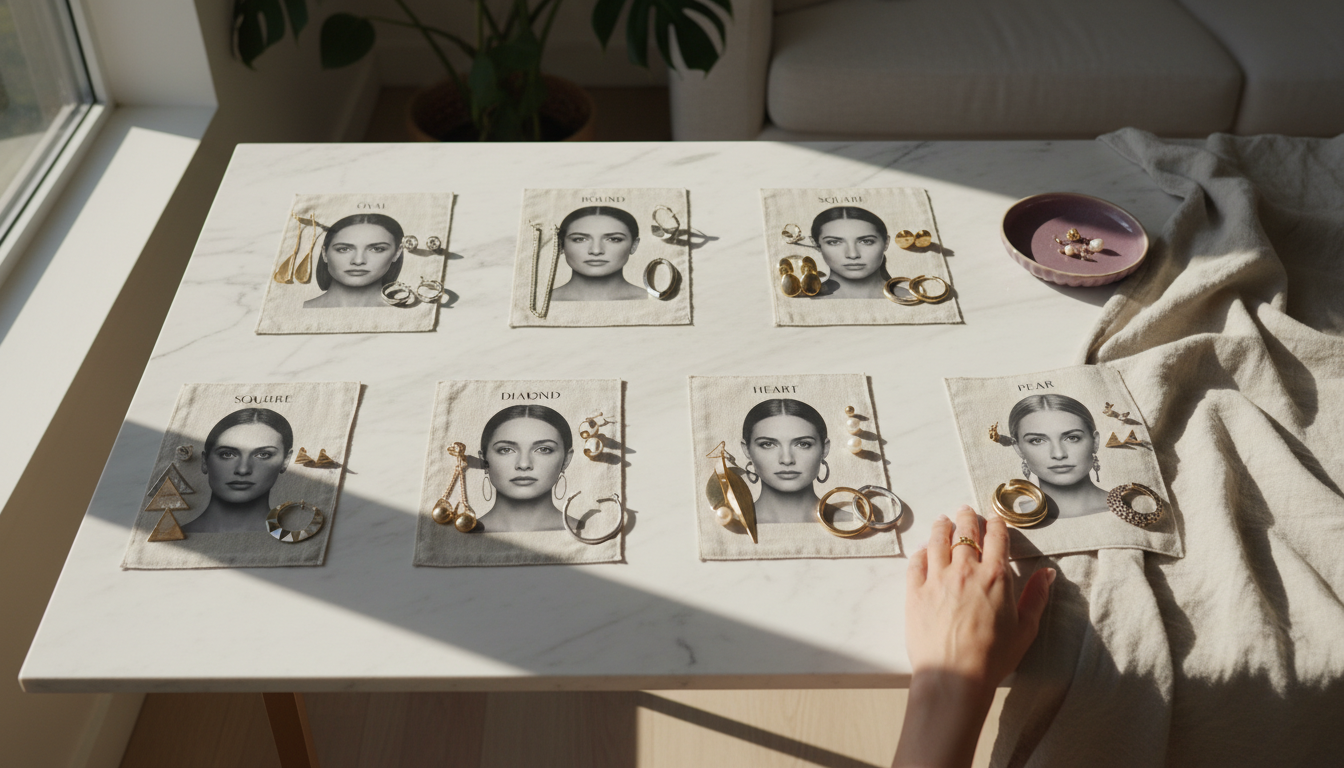
- Earrings: Shape and drop length change how your jaw and cheekbones read.
The ROI is straightforward. When you stop guessing, you buy fewer “almost” pieces, your morning mirror checks get faster, and photos feel more consistent. Instead of wondering if something is flattering, you can ask a sharper question: Does this support my face shape or fight it? That shift alone cuts a lot of decision fatigue.
The Mirror Test
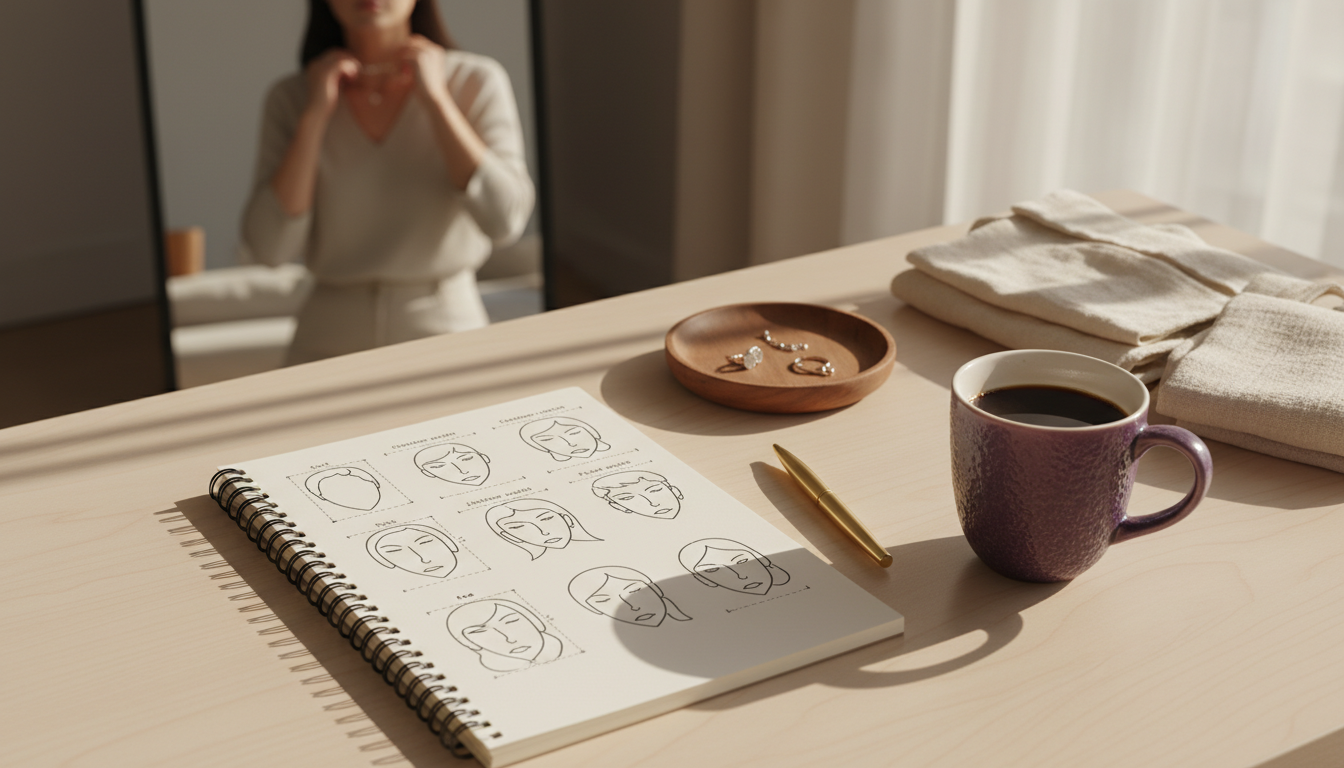
The mirror test is the simplest way to get a first read on your face shape. It’s low-tech, quick, and usually clear enough that you can rule out two or three shapes instantly. All you need is a mirror, good light, and something that can mark glass. I like this method because it forces you to look at the outline of your face, not your features or insecurities.
Here’s how I’d have you do it:
- Stand in front of a mirror at eye level in natural light.
- Pull your hair fully away from your face with a clip or headband.
- Keep your face relaxed, looking straight ahead, no tilting.
- Use lipstick, soap, or a whiteboard marker to trace the outer edge of your face: hairline, temples, cheek curve, jaw, chin.
- Step back and study the drawing, not your reflection.
Notice what shape it resembles most. Does it look more like a soft circle or a longer oval? Is the jawline quite straight and strong, or softer and more tapered? Do the cheekbones peak outward, giving you something close to a diamond, or does the widest point sit at the jaw, hinting at a triangle? This sketch gives you a quick shortlist. Later, measurements will confirm it, but this visual snapshot already starts saving you time by removing obviously wrong categories from consideration.

The mirror test focuses your eye on the outline of your face, not every tiny feature.
The Measurement Method
Measurements help you move from “this looks round” to “my cheekbones are actually the widest point.” You don’t need to obsess over millimeters; we’re looking for proportions and relationships. Use a soft measuring tape, or a strip of paper plus a ruler, and do this in front of a mirror so you can see what you’re doing.
Measure four points:
- Forehead width: Across the widest part, usually midway between brows and hairline.
- Cheekbone width: From the outer edge of one cheekbone to the other.
- Jawline width: From one jaw corner to the other, following the curve under your chin.
- Face length: From the center of your hairline to the tip of your chin.
Now compare the numbers rather than treating them in isolation. Ask:
- Is my face length more than 1.5× my cheekbone width, or closer to equal?
- Which is widest: forehead, cheekbones, or jawline?
- Is my jawline quite angular, or visually soft even if the measurement is wide?
These ratios translate directly into face shape categories. For example, if your face length is the largest number and much longer than it is wide, we’re in oval or rectangle territory. If width and length are similar, we’re choosing between round and square. Once you see the pattern in your numbers, every “what is my face shape” quiz starts making more sense, and future style decisions become grounded in actual data rather than vibes.

Basic measurements turn your face shape from a guess into a clear, repeatable framework.
The 7 Main Face Shapes
I work with seven main face shapes because it keeps the system practical without being overly abstract: oval, round, square, rectangle, diamond, heart, and triangle. You might not fit one perfectly, and that’s normal. I’m looking for the dominant pattern so I can build styling rules that save you time.
Here’s how I define them:
- Oval: Face length is about 1.5× width, with softly rounded jaw and forehead. Most things are easy to balance here.
- Round: Width and length are similar, with full cheeks and a soft jawline. The focus is usually on adding subtle angles and vertical lines.
- Square: Width and length are similar, but the jawline and forehead are straight and strong. Styling plays with curves and softness to temper the structure.
- Rectangle (or oblong): Like a longer square; face length clearly exceeds width, with relatively straight sides.
- Diamond: Cheekbones are the widest point. Forehead and jawline are narrower, and the chin can look more pointed.
- Heart: Forehead is wider than the jawline, with visible cheekbones and a narrower, sometimes pointed chin.
- Triangle (sometimes called pear): Jawline is the widest point, with a narrower forehead.
Once I know your category, I translate it into specific choices: where to put volume in your hair, how deep a V-neck should drop, which glasses bridge and frame thickness keep everything in harmony. This one-time clarity pays off every time you shop, especially online, because you can filter out entire styles that will almost never work for your proportions.
If you want this clarity without second-guessing every photo or purchase, I can read your face shape from a single selfie and turn it into concrete style decisions within seconds.
Know your face shape in seconds with Mira
Upload a selfie and I’ll pinpoint your face shape, then translate it into necklines, glasses, and everyday outfit choices you can use this week.

Common Confusions
People often get stuck between two similar shapes, and that’s where frustration comes in. The most common mix-ups I see are long vs rectangle, and square vs round. Sorting these out is worth it because each pair has slightly different styling needs, especially for haircuts and glasses.
For long vs rectangle, I look at the sides of the face and the jaw. If your face is clearly longer than it is wide but the sides curve gently and the jaw is softer, I treat it as long/oval. If the sides are quite straight, the jaw is prominent, and the overall outline feels more like a stretched square, I call it rectangle. That subtle distinction guides how much width I’ll add at the sides with hair or frames.
For square vs round, ignore weight and focus on bones. Ask yourself:
- Does my jaw create a fairly straight line from ear to chin, or is it more curved?
- Are my cheekbones defined but sitting inside a softer outline, or aligned with sharp corners?
- When I smile, do my cheeks “fill out” into a circle, or does the jaw still read as boxy?
If angles dominate, you’re square; if curves dominate, you’re round. When in doubt, I style for the structure I want to balance. That means if your jaw is strong but you love softness, I’ll lean into round-softening strategies. The point isn’t to win a quiz; it’s to understand your lines well enough that your hair, glasses, and accessories work with them, not against them.

A simple decision path turns “what is my face shape” into a quick, confident answer instead of a guessing game.
Quick Visual Guide
Sometimes the fastest way to understand face shape is to see it on someone familiar. I like using celebrities because you already have a mental library of their photos, angles, and hairstyles, which makes it easier to “read” the outline. Instead of obsessing over their features, study the frame: the border of hairline, temples, cheekbones, and jaw.
Here’s a quick mental grid you can use:
- Oval: Think Beyoncé or Timothée Chalamet. Most styles sit well on them because their proportions are balanced.
- Round: Selena Gomez or Leonardo DiCaprio in his 90s era. Faces where softness and width are more noticeable than angles.
- Square: Angelina Jolie or Henry Cavill. Strong jawlines, broad foreheads, overall structure.
- Rectangle: Sarah Jessica Parker or Benedict Cumberbatch. Longer faces with straighter sides.
- Diamond: Rihanna or Cillian Murphy. Cheekbones dominate, with narrower forehead and jaw.
- Heart: Reese Witherspoon or Ryan Gosling. Broader upper face tapering to a slimmer chin.
- Triangle: Jennifer Aniston in some earlier seasons of Friends or certain photos of Adam Driver, where the jaw looks wider than the forehead.
When you scroll or watch TV, start quietly sorting faces into these categories. Notice what haircuts and necklines they repeat that seem to work every single time. That practice trains your eye, which then speeds up your own decisions. You’ll spend less time asking “what is my face shape” and more time using that knowledge to build a wardrobe that consistently flatters you.

Seeing different face shapes on real people makes it easier to recognize your own and borrow their styling cues.
Know your face shape in seconds with Mira
Upload a selfie and I’ll pinpoint your face shape, then translate it into necklines, glasses, and everyday outfit choices you can use this week.