Dressing the Hourglass Figure: Emphasize Without Overwhelming
Hourglass Body Characteristics
When I talk about an hourglass body type, I’m describing a specific set of proportions, not a size. You’ll typically see shoulders and hips that are visually balanced, with a waist that clearly dips in between them. From the front, the outline has a soft S-curve; from the side, there’s usually some fullness through the bust and seat. You might notice that even in basic pieces, fabric naturally follows your curves instead of hanging straight down. That natural shape is a strength, and every styling choice should work with it instead of flattening or hiding it.
To check whether you lean hourglass, I like a simple three-point scan in the mirror. First, compare your shoulders and hips: do they sit on roughly the same vertical line? Second, look at your waist: is there a noticeable inward curve, even when you’re in a T-shirt? Third, pay attention to how most tops and bottoms fit: do things often fit your hips and gap at the waist? If you’re nodding yes, you’re likely working with some version of an hourglass frame, even if you don’t match an “idealized” image online.
I also see a lot of hourglass women underestimate how structured their bodies already are. Because your skeleton and soft tissue create that built-in shape, you don’t need extreme darts or corsetry to “fake” it. Instead, you benefit from clean, intentional lines that trace what’s already there. Recognizing these characteristics saves you time and returns because you can quickly dismiss pieces that fight your proportions. Once you see your body as a set of lines and curves, not a problem to fix, shopping becomes a lot more strategic and much less emotional.
The Styling Goal
For an hourglass figure, the core styling goal is simple: keep your waist visible while maintaining the natural balance between shoulders and hips. I want your outfits to read as “effortlessly shaped,” not squeezed or hidden. That means clothes should follow the body, not cling aggressively or drape like a tent. When you hit that sweet spot, you look polished even in jeans and a tee, and you spend less energy adjusting, tugging, or second-guessing in the mirror.
Think of your waist as the anchor point of every look. If a piece erases that anchor, the whole outfit starts to feel heavier or boxier than you are. If a piece exaggerates it too sharply, you can tip into costume territory, where curves are the only thing people see. So I filter silhouettes with three questions:
- Does this show some hint of the waist from at least one angle?
- Do my shoulders and hips still feel visually balanced?
- Is the fabric skimming rather than strangling my curves?
When you use this framework while shopping online, you scroll differently. You’re no longer chasing generic “cute” pieces; you’re scanning for waist definition and proportion first, then color and detail. That habit reduces try-on chaos and impulse buys that never quite sit right on your body. Over time, your closet fills with items that naturally cooperate with your shape, which means faster mornings and fewer “nothing works” spirals.
Winning Silhouettes
Hourglass bodies thrive in silhouettes that respect the curve of the waist and keep the vertical line clean. I tend to reach for fitted, wrap, belted, structured, and tailored shapes because they echo your natural architecture. None of these have to feel formal; they can show up in a jersey wrap dress, a belted trench, or a crisp knit tee with shoulder seams in the right place. The unifying idea is controlled volume: close to the body through the core, with room where you need movement.
Here are silhouettes I see working consistently well:
- Fitted but not tight: Think body-skimming knit tops, slim tees, and sweaters with a defined shoulder and gentle waist shape.
- Wrap styles: True or faux wraps that secure at the side and create a diagonal line across the torso.
- Belted pieces: Trench coats, shirt dresses, and blazers with belts that sit at or just above your natural waist.
- Structured tailoring: Blazers, trousers, and skirts with seaming that shapes rather than flattens.
When you build outfits around these silhouettes, your curves look intentional instead of accidental. You avoid the common trap of “hide everything under something big,” which usually backfires and makes you appear larger than you are. You also sidestep ultra-stretch, unstructured pieces that cling in some places and collapse in others. Over time, you train your eye to recognize winning shapes on a product page within seconds, which cuts shopping time and helps you stop ordering pieces that only work from the front in perfect lighting.

The Fit Challenge
Most hourglass shoppers run into the same headache: straight-size clothes are cut for a straighter torso than the one you actually have. Brands often design for a fit model whose waist-to-hip ratio is mild, then grade sizes up and down from there. On an hourglass frame, that shows up as gaping waistbands, button-downs that pull across the bust, and dresses that fit hips but bag around the midsection. You’re not “the wrong shape”; the pattern simply wasn’t drafted with your proportions in mind.
Instead of chasing the unicorn piece that fits perfectly off the rack, I like to separate two tasks: getting close, then tailoring. Get close by fitting to the fullest point first:
- For bottoms, fit the hips and seat; ignore a bit of waist gaping.
- For tops and dresses, fit the bust and shoulders; accept some extra room at the waist.
Then use simple tailoring to refine. A tailor can:
- Take in the waistband at the back so trousers sit flush.
- Add subtle darts to the back of a dress or blouse.
- Shorten straps so the waist seam hits at your actual waist.
These small adjustments turn average pieces into workhorses that genuinely fit your body. Yes, there’s a cost, but the ROI is real: fewer returns, fewer “almost right” items lingering in your closet, and a smaller wardrobe that actually functions. If you mentally add a tailoring line to your budget, you release the pressure on every item to arrive flawless, and you focus instead on fabric, cut, and potential.

Tops That Work
When I’m choosing tops for an hourglass figure, I’m looking at three things: neckline, waist shape, and fabric structure. V-necks, open collars, and modest scoop necks are especially effective because they create vertical space through the center of the body while framing the bust. This draws the eye inward and downward instead of straight across the chest. I also prefer tops that either end around the hip bone or are long enough to tuck smoothly; awkward mid-length hems often add bulk exactly where you don’t want it.
Strong options include:
- V-neck and wrap tops: These break up the chest area and highlight the waist.
- Fitted knits: Ribbed or compact cotton knits that sit close to the body without clinging at every line.
- Structured blouses: Woven shirts with darts, princess seams, or a subtle peplum that nips in at the waist.
Fabric matters as much as cut. Ultra-thin, floppy jerseys tend to outline every curve and can make you feel exposed, while stiff, boxy fabrics ignore your shape completely. I like a middle ground: fabrics with some weight and recovery that smooth over curves and hold a clean line. When your tops work this hard, they instantly elevate denim, trousers, and skirts you already own. You spend less time adjusting bra lines or tucking and retucking, and more time actually getting out the door on time.

Bottoms That Work
Bottoms are where most hourglass bodies feel the fit struggle first, so I focus on shapes that respect your hip curve and meet your waist. High-waisted cuts are usually your friend because they land closer to your natural waist and prevent that back-gap issue. When the waistband sits at the narrowest part of your torso, your legs read longer and your proportions feel grounded. Mid-rise can work too, but only if it still creates a visible waist and doesn’t cut across your widest point.
For silhouettes, I like:
- Pencil skirts: Skimming, not strangling, and ending at the knee or just below.
- Bootcut or gentle flare jeans: These balance the fullness of your hips and create a clean line from hip to hem.
- Structured trousers: Straight or slightly tapered legs with enough room through the hip and seat.
Prioritize fabrics with structure: denim with a bit of stretch but not full jegging territory, suiting with a smooth drape, or ponte that holds shape. Very thin stretchy fabrics tend to slide down and bunch, while ultra-stiff styles can dig in and create harsh lines. When you have 2–3 bottom silhouettes that you trust, your entire wardrobe becomes more efficient. You can pair any of your go-to tops with them and know the proportions will behave, which saves you from trying on five pairs of jeans before you leave the apartment.
Dresses
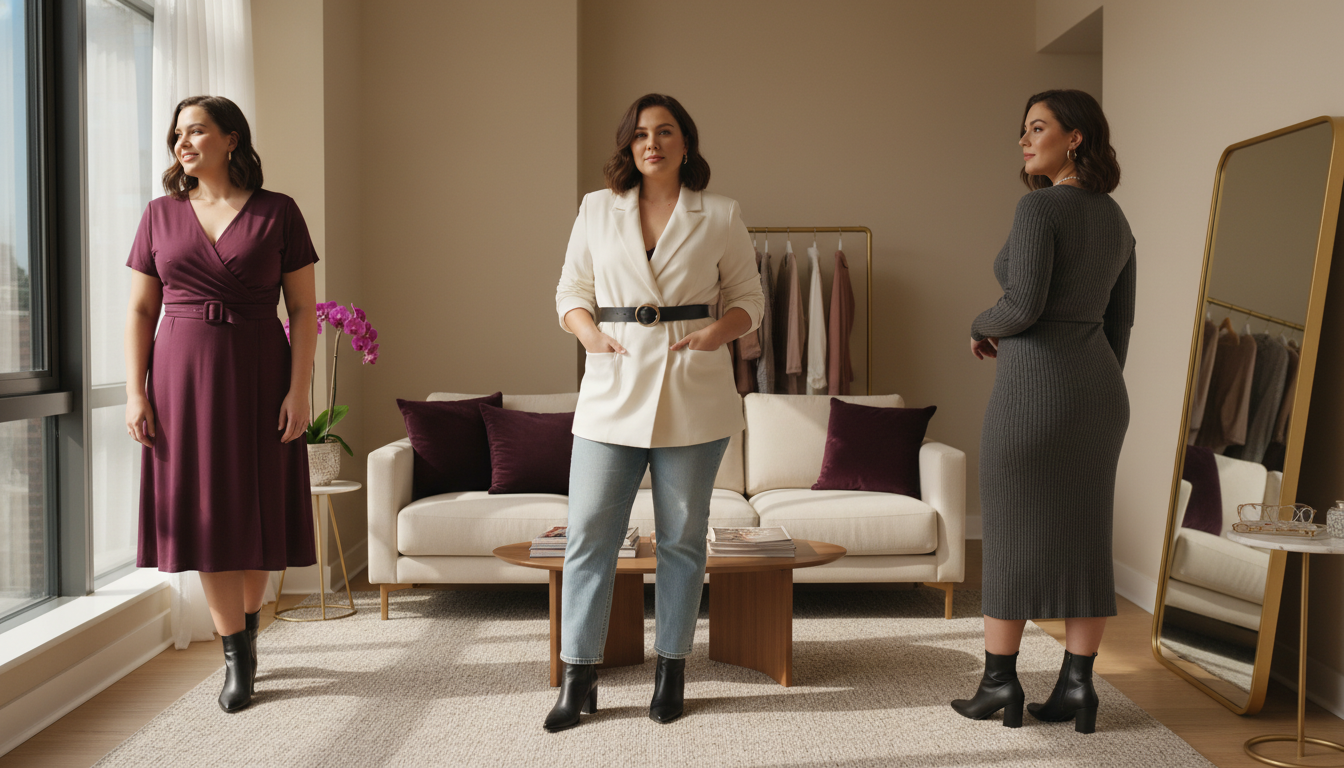
Dresses can be a secret weapon for hourglass bodies because a single well-cut piece can handle shape, proportion, and polish in one move. Wrap dresses are the classic example: the tie naturally lands near your smallest point, the diagonal line across the torso creates length, and the skirt skims over hips without clinging. Fit-and-flare styles offer a similar effect by defining the waist, then releasing into a gentle A-line that follows your curves instead of fighting them.
Sheath dresses also work beautifully when they’re tailored. Look for versions with seams that contour the waist and enough structure in the fabric to smooth rather than hug every detail. A thin belt can help fine-tune the shape, especially on shirt dresses or T-shirt dresses that otherwise read straight. I often suggest experimenting with belt placement: try at your natural waist, then one finger-width above, and notice which feels more balanced.
The framework I use for dresses is simple:
- Can I see the suggestion of a waist from the front and side?
- Does the skirt or lower half skim smoothly over hips and thighs?
- Can I move, sit, and lift my arms without everything shifting dramatically?
When a dress passes that test, you’ve found a high-ROI piece. It becomes an automatic grab for dinners, office days, and events, giving you a polished look with almost no decision-making. Over time, a small rotation of reliable dresses can replace a lot of fussy separates that never quite make it out of your closet.
What to Avoid
I don’t like strict “rules,” but there are certain shapes that consistently work against an hourglass frame. Oversized, shapeless pieces are at the top of that list. When everything is big and boxy, your waist disappears and your body can look heavier and less defined than it actually is. Drop-waist styles create a similar issue by pushing the visual waistline down onto the hips, which shortens the legs and muddles your natural curves.
I also watch for excessive volume in the wrong places. Tiered ruffles around the hips, extreme balloon sleeves with no waist definition, or bulky pockets over the bust can all distort your proportions. The problem isn’t any single detail; it’s when volume piles up without structure to balance it. To simplify your filter when shopping, be cautious with:
- Drop-waist dresses and tops that sit low on the hip.
- Ultra-boxy knits and tees with no shape through the torso.
- Smock and baby-doll styles that start wide at the chest and keep going.
Avoiding these doesn’t mean avoiding comfort or ease. You can absolutely wear relaxed pieces; they just need one grounding element: a defined shoulder line, a half-tuck, a belt, or a shaped hem. When you notice patterns in what fails you, you buy with more intention, return less, and release the guilt around “why doesn’t this work on me?” The answer is usually the cut, not your body.
If you want this clarity to show up in your mirror and in your cart, I can walk you through exactly which pieces will earn their place in your hourglass wardrobe in just a few days of focused guidance.
Dress your curves with calm confidence
In under a week, I’ll pinpoint the brands, cuts, and silhouettes that love your hourglass shape—so getting dressed feels fast, clear, and intentional every morning.

Outfit Formulas
To make mornings easier, I like to translate all of this into a few repeatable outfit formulas. Think of them as templates: you can swap colors and textures, but the proportions stay consistent. For an hourglass body, formula-based dressing is especially powerful because once you learn what feels balanced, you can recreate it in seconds. Here are five combinations I return to again and again.
- Formula 1: Wrap top + high-waisted straight jeans + ankle boots. The wrap defines your waist, the jeans follow your hip line, and the boots lengthen the leg.
- Formula 2: Fitted knit turtleneck + pencil skirt + sleek sneakers or low heels. Clean lines through the torso and a skirt that skims keep the silhouette sharp.
- Formula 3: Belted blazer + simple tank + tailored trousers. The belt pulls in at your smallest point while the blazer and trousers create structure.
- Formula 4: Fit-and-flare dress + minimal jacket + block-heel boots. The dress does the shaping; the jacket adds polish without hiding your waist.
- Formula 5: Sheath dress + thin waist belt + loafers. The belt fine-tunes the fit and the shoes keep it modern and grounded.
When you identify a few formulas that feel like you, screenshot them or write them down. Use them as a checklist when you shop so every new piece clearly plugs into at least one combination. That’s how you move from a closet full of pretty one-offs to a wardrobe that works hard for your hourglass shape, your schedule, and your energy.

Dress your curves with calm confidence
In under a week, I’ll pinpoint the brands, cuts, and silhouettes that love your hourglass shape—so getting dressed feels fast, clear, and intentional every morning.